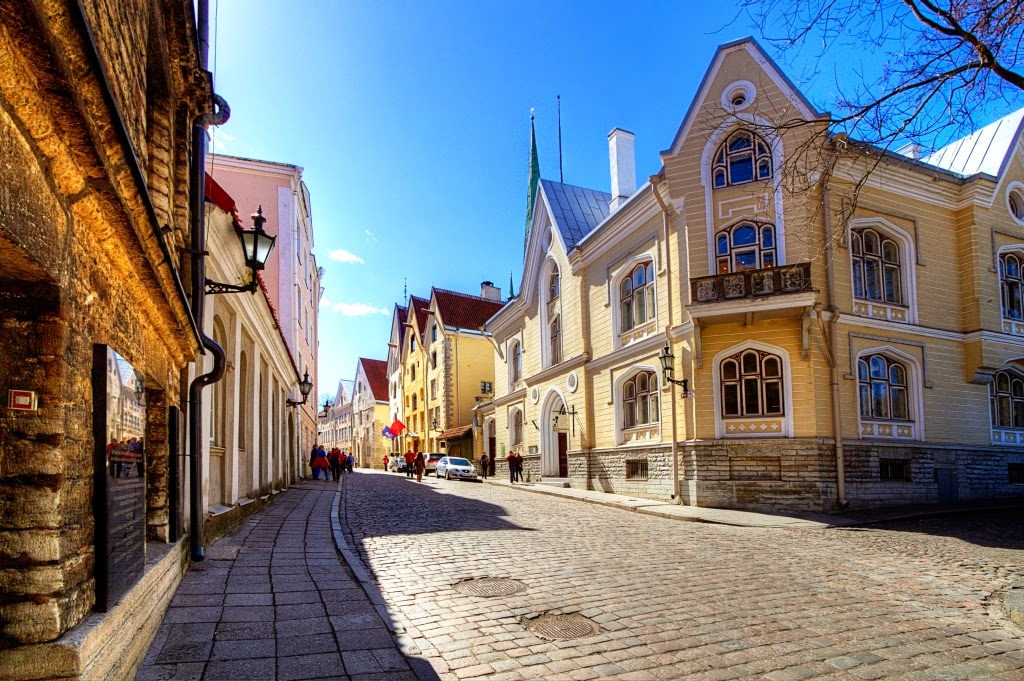
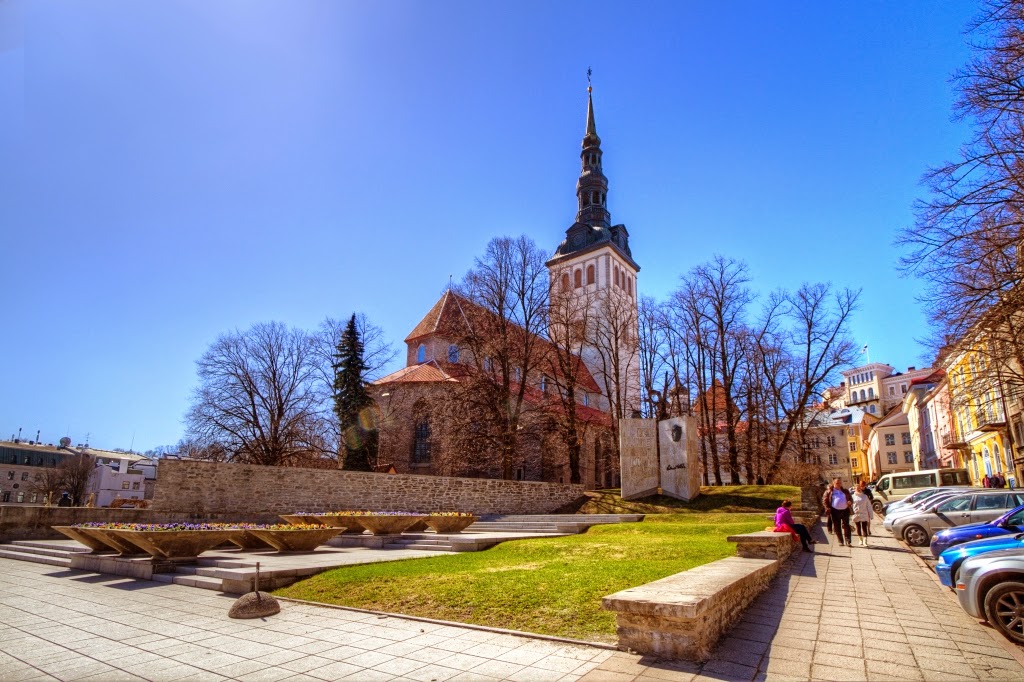
Sunday, July 21, 2013

Porvoo and Helsinki, Finland

Anne arrived quite late the night before, and we headed to bed not too late so we wouldn't be tired for today's explorations.  Jaana's friend Sari joined us, in fact she drove us which was brilliant.  She's so nice.  So there we were, Jaana, Sari, and I all with Cochlear Implants.  Sari spoke no English.  So translation between us would go something like. Sari - Finnish - Jaana then translated it to English, which Anne listened to then said it again so I could understand if I couldn't work it due to Accents.  But we were all patient and no one minded and we all had a fun day.

Sari drove us to Porvoo, about an hour's drive away from where Jaana lived.  Porvoo is the second oldest city in Finland.  It's picturesque city centre of old wooden houses is a proposed Unesco World Heritage site. Porvoo has been around since the 13th century, although most of the present buildings date to the 19th century. In 1809, Finland's nobles assembled at the Diet of Porvoo to affirm the country's conquest by Russia.


It was a beautiful day, albeit a tad cold. We parked the car then strolled over the river and got these gorgeous vistas..

These are the wooden shore houses that line the river, which make Porvoo famous.  Further down are the wooden warehouses which are also about to become Heritage buildings.

Over the bridge, then up that street - we made our way to the Porvoo Cathedral.

A heavy, squat, white stone building, this church wins no awards for architectural innovation, but it's among the oldest and largest in Finland, with parts dating back to the 11th century. Predating the Reformation, it was originally a Catholic church, but was somewhat crudely converted into a Protestant one later on by removing icons and painting over murals. The building was burned down four times between 1300 and 1700, and took a direct hit from a bomb in 1914 — miraculously, the bomb fell through the roof, but did not explode. The roof was burned by an arsonist in 2006, but the damage was repaired and it's now open again, with some of the Catholic-era murals restored in the process.

When we arrived, we were in time to hear a choir of locals warming up, and it was a lovely sound.  I didn't really want to leave. If you look closely you'll see a painted icon of a Unicorn on the far arch on the right.  I couldn't find any information about it but it looked ancient.

Most of the houses were wooden, except for this one, and I vaguely remember reading it was something to do with either a rich merchant or the Mayor. Whatever it was, it was the most 'wealthiest' looking house in town.

It was pretty cold, and spring was 2 months late, but there were signs that it was warming up...  There were also crocuses and tulips about - so pretty. We did stop to get a hot chocolate, from this little shop, and I got an amazing Chilli one.  It was so nice, I went back and bought a packet of it which I have brought home. While we were drinking the hot drinks just outside, I noticed a rubbish bin catch fire from someone's cigarette butt, and because it's all wooden buildings we alerted the shop owner who came out with some water to put it out.  Our excitement of the day!  We saved the town!

One of the many gorgeous looking wooden houses that we found while strolling around the old town.

Another house and we questioned the paint job.  The yellow house, painted the side of the blue house the same colour as their house. We wanted to  know if they had to get permission, or whether they could just do it!

We walked back into the town where all the shops were and found Brunberg. One of Finland's most famous confectioners, this family-run business was founded in 1871 and is best known for their Pusu ("Kisses"), or giant puffs of flavored whipped cream encased in a thin chocolate shell. (Until recently, they were known somewhat politically incorrectly as "Negro Kisses".) Brunberg's liquorice (lakritsi) is another local favorite, and the chocolate truffles were to die for. I bought a big bag of them, which Anne and I divvied up back home.  I brought some home to NZ but they didn't last long!  Here Jaana and Sari pose for me outside the shop.

Inside the shop was a map where all their visitors could place a pin on where they were from. They get a lot of European visitors, but sadly, only THREE people were from New Zealand - and two of those were Anne and I!!  

Here is the Australia/NZ part a bit closer.  Anne is the Red (Auckland)  I'm the White - Blenheim, and someone else comes from somewhere on the West Coast of the South Island.


An Antique shop that we explored. Saw lots of things I would love but no way to get them home. 

One of the many wooden buildings - I think this one is a Museum.

Back down to the river where I spied the famous red-coloured wooden storage buildings on the riverside which are a part of the proposal for the Unesco World Heritage Site.


A quick photo on the bridge before we head back to Helsinki for another exploration in the city...

We drove back to Jaana's place, parked the car there then we all caught the metro into town. As we passed the sea, I actually saw people swimming.  Now it was freezing cold, I wouldn't have even put my toe in the water, so I reckon these Finns crazy!!

We got out of the tram and this is what greeted us. The most amazing sight of the Helsinki Cathedral and this very important 'town' square. The Cathedral is the Finnish Evangelical Lutheran cathedral of the Diocese of Helsinki, located in the neighbourhood of Kruununhaka in the centre of Helsinki, Finland. The church was originally built from 1830-1852 as a tribute to the Grand Duke of Finland, Tsar Nicholas I of Russia. It was also known as St Nicholas' Church until the independence of Finland in 1917.

The church's plan is a Greek cross (a square centre and four equilateral arms), symmetrical in each of the four cardinal directions, with each arm's façade featuring a colonnade and pediment. Engel originally intended to place a further row of columns on the western end to mark the main entrance opposite the eastern altar, but this was never built.

The cathedral sits on the Senate Square which has been the main square of Helsinki since the 17th century. It was transformed into its current form in the early 19th century, when Russian Tsar Alexander II, moved the capital of Finland from Turku to Helsinki. The buildings on the four sides of the square represent the four powers of the state as conceived at the time: senate, church, university and commerce. The old merchant houses are now mainly occupied by city offices, but there is also a nice café, and a bazaar. While the square is a popular tourist destination, the steps on the north side are commonly used as a meeting place, a venue for student meetings, sun bathing or even studying.

I loved the Cathedral against the blue sky, and the white pillars.  I loved the people around enjoying the sunshine and sitting around talking.  What a beautiful place.

Inside the Cathedral was just as beautiful. It gets around 400,000 visitors per year, so it's a pretty popular place.
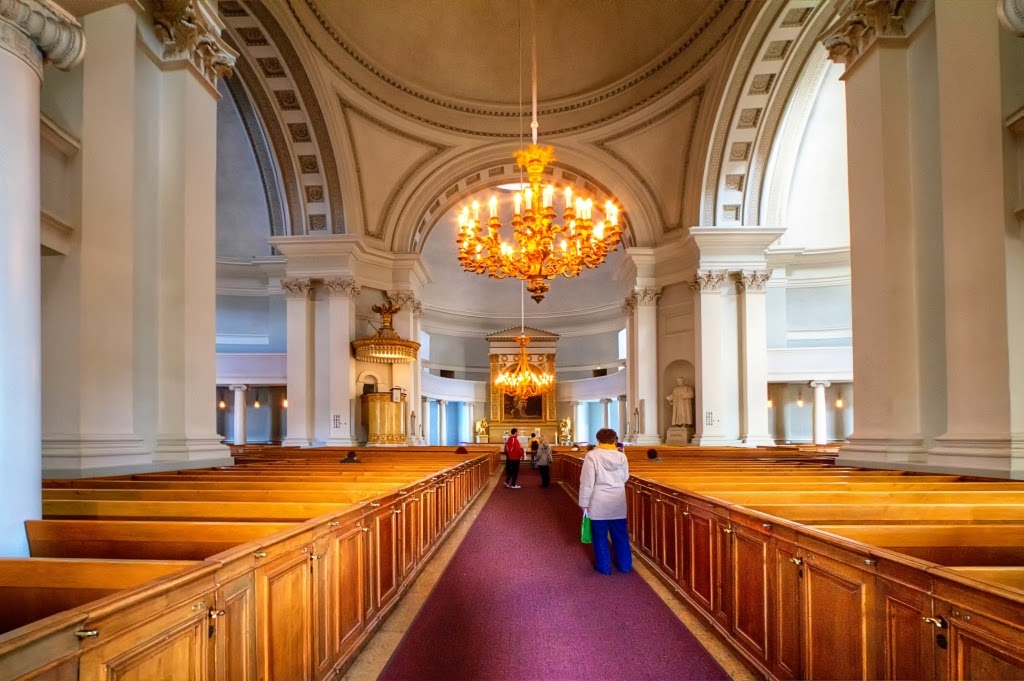
Very clean lines and not cluttered, which made it lovely, light and airy.

The Organ pipes were impressive.


 And I loved the lights outside the cathedral as well.

Even under the electric wires for the tram, the place looks amazing.

After leaving the cathedral, we wandered down to the waterfront and looked at the ticket office for the times for our trip the next day  Drank in the views then wandered up to the Greek Orthodox Church on the hill. 
Uspenski Cathedral is an Eastern Orthodox cathedral in Helsinki, Finland, dedicated to the Virgin Mary. Its name comes from the Old Church Slavonic word uspenie. Designed by the Russian architect Alexey Gornostaev (1808–1862). The cathedral was built after his death in 1862–1868.

The Cathedral is set upon a hillside on the Katajanokka peninsula overlooking the city. On the back of the cathedral, there is a plaque commemorating Russian Emperor Alexander II, who was the sovereign of the Grand Duchy of Finland during the cathedral's construction. Main cathedral of the Finnish Orthodox Church in the diocese of Helsinki, Uspenski Cathedral is claimed to be the largest orthodox church in Western Europe.

The cathedral has several valuable icons, among others St. Nicolas – The Wonder Maker, which was stolen on 16 August 2007 between midday and 1 p.m. in broad daylight while hundreds of tourists were visiting the cathedral. The icon is from the 19th century and is of a rare variant. Originally it was given to the Orthodox Cathedral of Vyborg, from where it was moved to Helsinki during the Second World War. No further details of its origin are known  The icon, being 45 by 35 centimetres (18 in × 14 in), was placed in a kiota (a glass covered protection frame) and weighs a couple of kilograms. It was on display on a lectern. The icon is now being searched for in Finland as well as abroad.

Another icon, Theotokos of Kozeltshan was stolen in June 2010, but recovered in February 2011.

No photos at all were allowed to be taken inside the church, but 'my camera went off automatically' so I got a couple! Having never been in a church like this before, I thought it was amazing.


Managed to get Anne to relax on the grass for a couple of photos.

Afterwards we headed back along the waterfront and had a hot drink in a nearby cafe.  The cafe was rather nice.


A tram ride then took us to the main station. Both Anne and I thought it looked very communist architectural wise.  But it was built by a Russian Architect so it was no wonder.  Very beautiful inside, and large and spacious.  I learnt here that St Petersburg was only a four hour train journey from this station, and a train was leaving very shortly.  I felt like getting on - I hadn't realised how close to Russia I really was!!  So near and I didn't get there!


We then caught the metro back to the train station and stayed up talking for a while, drinking lots of tea, and eating bread and cheese.  Another fun day full of amazing sights.

Saturday, July 20, 2013

Finland, and Tallinn, Estonia

It's about time I started my blog up again.  I had every intention to do so while I was travelling, but I simply got too tired.  By the time I had done a bit of sightseeing, talked to friends, had a glass of wine, I didn't have the energy to do anything but download the photos of my camera.

Then when I got home, everything seemed too much - I had simply taken too many photos.  It took me two months before I could pick up my computer and look at where I had been.  Although it's interesting because some of my images I had completely forgotten about.

I'm starting where I left off - after my day in the Netherlands at Keukenhoff Gardens. The following morning I flew to Finland via Munich, Germany. Jaana was at the airport to meet me and we had so much to say to each other, I didn't even pick up my camera to take a photo, or even look out the window of the bus or train to see where I was going!  Jaana and I had known each other for years on the Say What? Club listserv, that caters for the Deaf and Hard of Hearing.  We had talked in chat groups and by email since the mid 90s, so we were like old friends straight away with so much to talk about!!   

We had an early night as we were heading to Tallinn, Estonia the next morning by ferry.  We booked online then headed to bed.  The next morning we popped into Jaana's work on the way to the ferry to print the tickets and then we were off.  We caught the 9am ferry and I have to say I was pretty impressed.  It was the size of a cruise ship, and luxurious too.  Just a two hour trip to another country. Really, our ferries between Wellington and Picton need to take a leaf out of these guys books in terms of service, luxury, size and speed!  We settled down at the front of the ship with a drink and our phones taking advantage of the free Wi-fi.  In comfort....

We arrived in Tallinn about 11.00am. I had printed out a self guided tour which we did together. Together with two brains, we hoped we wouldn't get lost! Jaana managed to find the start of the walk. If it had been left to me, we would probably still be looking for it!

The start of the walk was at Fat Margaret's Tower. (No offence to any Margarets!). Fat Margaret Tower guarded the entry gate of the town (in medieval times, the sea came much closer to this point than it does today). The relief above the gate dates from the 16th century, during the Hanseatic times, when Sweden took Estonia from Germany.

Through the gate into Picc Street which means 'Long Leg'.  This street goes through the lower town and takes one to the upper town.  The city once consisted of two feuding medieval towns separated by a wall. The upper town—on the hill, called Toompea—was the seat of government ruling Estonia. The lower town was an autonomous Hanseatic trading center filled with German, Danish, and Swedish merchants who hired Estonians to do their menial labour.

I loved the medieval architecture... The street was the main drag for the medieval Merchants - many were warehouses complete with cranes in the gables. Below is one merchant’s home nicknamed the “Three Sisters” and is a textbook example of a merchant home/warehouse/office from the 15th-¬century Hanseatic Golden Age.


St. Olav’s Church (Oleviste Kirik, a Baptist church today), notable for what was once the tallest spire in Scandinavia. Its plain whitewashed interior is skippable according to our guide, though climbing 234 stairs up the tower rewards you with a great view. Jaana and I discussed whether to climb the tower, and decided that we didn't have the energy, but we did decide to see for ourselves whether the interior was skippable.

I'm glad I did because I found this lovely door...


And although the interior was plain and simple, I sitll thought it was rather beautiful. I thought perhaps because it was bare, that perhaps over the years it may have been pillaged.  Compared to the great cathedrals of Italy, the walls were devoid of art.

Back on to Pikk Street.. While we see a peaceful scene today, many of the buildings remind locals of the dark times under Moscow's rule. The KGB used the St Olav's Tower to block Finnish TV signals, and this building was local KGB headquarters. “Creative interrogation methods” were used here. Locals well knew that “from here started the road of suffering,” as Tallinn’s troublemakers were sent to Siberian gulags. The ministry building was called “the tallest building in town” (because “when you’re in the basement, you can already see Siberia”).  

I had to keep taking photos of the buildings - simply because I loved the doorways, and the crumbling exteriors, and the shapes.


Little alleyways looked interesting to explore, because of the colourful buildings and cobblestone streets.

Church of the Holy Ghost (Pühavaimu kirik) was our next visit.  The clock is from 1633, and the plaque on the wall is in Estonian and Russian. Before 1991, things were designed for “inner tourism” (within the USSR). This church retains its 14th-century design. In the back, the old flag of Tallinn—the same as today’s red and white Danish flag—recalls the 13th-century Danish rule. (The name “Tallinn” means “City of the Danes”.) The Danes sold Tallinn to the German Teutonic Knights, who lost it to the Swedes, who lost it to the Russians. Except for two decades in the early 20th century, Tallinn remained Russian until Estonia regained its independence in 1991.

Note how old those wooden doors are...


Inside above the altar, is a piece of beautiful ancient artwork, of which I've seen similar ones at Art Museums around the world. Priceless and valuable, and beautiful.

Next up was the Town Square...  A marketplace through the centuries, thishas many fine old buildings and is a reminder that this was the center of the autonomous lower town, a merchant city of Hanseatic traders. Once this was the scene of criminals chained to pillories for public humiliation and knights showing off in chivalrous tournaments; today it’s full of Scandinavians savouring the cheap beer, children singing on the bandstand, and cruise-ship groups listening to their guides!

St. Nicholas’ (Niguliste) Church is a 13th-century Gothic church-turned-art-museum but used to serve the German merchants and knights that lived in this neighborhood 500 years ago. The Russians bombed it in World War II: In one terrible night, on March 9, 1944, Tallinn was hit, and the area around this church—once a charming district, dense with medieval buildings—was flattened.

The concrete steps up to the church were damaged, and I can only surmise a bomb did this, as I can think of nothing else that might do this much damage to concrete.


We then climbed up to the Danish Kings Garden, and looked out over the rooftops of the Lower City, then popped through the wall.  We were now in the upper town. We watched people do archery for a brief moment then walked to the Russian Orthodox Church right just above the archers.

The Alexander Nevsky Cathedral was built here in 1900 over the supposed grave of a legendary Estonian hero—Kalevipoeg. While it’s a beautiful building, most Estonians don’t like this church. Built to face the national parliament, it was a crass attempt to flex Russian cultural muscles during a period of Estonian national revival. We stepped inside to find it really busy.  

No photos were allowed, but I managed to fire one off.  I wonder if the ladder there is the 'Stairway to Heaven?

Across the street is the pink palace—an 18th-century addition that Russia built onto the Toompea Castle. Today, it’s the Estonian Parliament building, flying the Estonian flag—the flag of both the first (1918–1940) and second (1991–present) Estonian republics. (Locals say they were always independent...just occupied—first by the Soviets, then by the Nazis, and then again by the USSR.) Notice the Estonian seal: three lions for three great battles in Estonian history, and oak leaves for strength and stubbornness. Ancient pagan Estonians, who believed spirits lived in oak trees, would walk through forests of oak to toughen up. (To this day, Estonian cemeteries are in forests. Keeping some of their pagan sensibilities, they believe the spirits of their departed loved ones live on in the trees.)

From here we walked around the Upper Town. It was pretty hot. I loved the blue skies, the buildings, the colours, the old street lamps, and all the flags. This the Tall Hermann Tower: This tallest tower of the castle wall is a powerful symbol here. For 50 years, while Estonian flags were hidden in cellars, the Soviet flag flew from Tall Hermann. As the USSR was unraveling, the Estonians proudly and defiantly replaced the red Soviet flag here with their own black, white, and blue flag.

We came across an old medieval door complete with armour...


Patkuli Viewpoint:  In the distance, ferries shuttle to and from Helsinki (just 50 miles away). Beyond the lower town’s medieval wall and towers stands the green spire of St. Olav’s Church, once 98 feet taller and, locals claim, the world’s tallest tower in 1492. Beyond that is the 985-foot-tall TV tower (much appreciated by Estonians for the heroics involved in keeping the people’s airwaves open during the harrowing days when they won independence from the USSR). During Soviet domination, Finnish TV was responsible for giving Estonians their only look at Western lifestyles. Imagine: In the 1980s, many locals had never seen a banana or pineapple—except on TV. People still talk of the day that Finland broadcast the soft-porn movie Emmanuelle. An historic migration of Estonians flocked from the countryside to Tallinn to get within rabbit-ear’s distance of Helsinki and see all that flesh on TV.

After all that walking I was more than ready to sit down and have dunch, or linner, or more simply - one very late lunch.  I tried a local dish - sausages and sauerkraut.  It was rather nice, especially with the beer!

We headed back down to the lower town after lunch as we had time to view the big department store before heading back to the ferry.  On the way I passed my old Auckland suburb!!


And Jaana found a new friend!

We also passed this amazing flower market - stall after stall.  I wish I could have somehow recorded the scent - it was divine.

And the blue Crysanthemums were rather pretty.

Inside the department store I was sorely disappointed when I found no bargains.  Shoes were between 300 and 600 euros, and handbags not much cheaper.  Clothes were also expensive.  I hope the Estonians have cheaper areas to shop than this!  But I did see beautifully dressed peoples shopping and spending money.  I felt very scruffy in my walking shoes and jeans!

Our ferry back...

While Jaana explored the duty free, I found a place I could get outside on the boat and take photos of the sunset.  The sea was like glass.


Back in Helsinki Port, we passed lots of low lying islands, some with houses on them.  I hope the sea doesn't rise too much higher!

And seagulls wheeled and cawed around the ship as we were docking.

We got back to Helsinki about 9pm and Anne flew in from Netherlands a few hours later to explore Finland with us.  But I really enjoyed my day.  If anyone wants a copy of the walking tour - please either leave your email in a comment and I'll email you the document, or press that contact me up the top right and ask for one with your email address.  I fully recommend a day in Tallinn.

I apologise how many images there were in this post - but I did cut it down as much as I could!